
Dialogue
Cleaning Up
Vocabulary and phrases
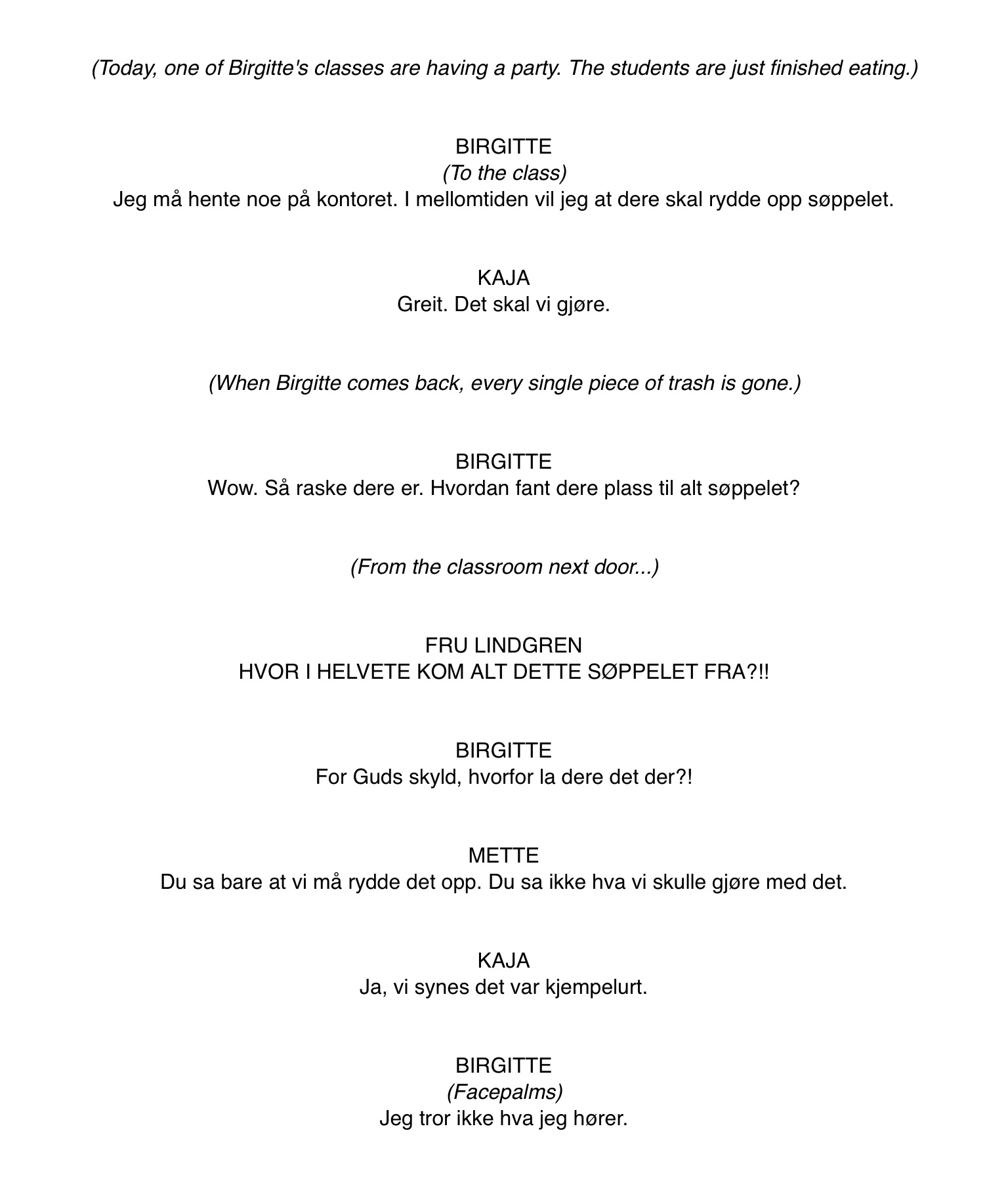
Jeg må hente noe på kontoret. I mellomtiden vil jeg at dere skal rydde opp søppelet. I have to get something at the office. In the meantime, I want you (plural) to clean up the trash.
- å hente to get, to fetch
- et kontor an office
- i mellomtiden in the meantime
- å rydde opp to clean up
- søppel trash
Greit. Det skal vi gjøre. Okay. We’ll do that.
- greit okay, all right
Wow. Så raske dere er. Hvor fant dere plass til alt søppelet? Wow. You (plural) are so fast. Where did you find room for all the trash?
- rask fast
- fant (from å finne) found
- plass room, space
Hvor i helvete kom alt dette søppelet fra?!! Where the hell did all this trash come from?!!
- helvete hell
For Guds skyld, hvorfor la dere det der?! For God’s sake, why did you (plural) put it there?!
- for Guds skyld for God’s sake
Du så bare at vi må rydde det op. Du så ikke hva vi skulle gjøre med det. You just said that we had to clean it up. You didn’t say what we should do with it.
- skulle should
Ja, vi synes det var kjempelurt. Yeah, we think it was very clever.
- synes think (for opinions)
- lurt smart, clever
- kjempelurt very clever
Jeg tror ikke hva jeg hører. I don’t believe what I’m hearing.
- tror believe
Grammar
For today’s lesson, we are going to learn the difference between å synes (present tense: synes) and å tro (present tense: tror). If you look back at the end of the dialogue, you see an example of both. In English, both words are translated as ‘think’, but refer to different applications of that word, as illustrated in the dialogue.
Å synes is used to express something that is merely an opinion. For example, you may want to say something is difficult – Jeg synes det er vanskelig (I think it is difficult). But another person may think that the same thing is easy – Jeg synes det er lett (I think it is easy).
Å tro is used to express something that you think is true, but may not be – Jeg tror at hun er hjemme (I think that he’s home). It is also used to express conviction, such as talking about faith – Jeg tror på Gud (I believe in God).
For those of you that learn grammar best through video, here’s one that I think is very helpful:
 Polyglot in Progress