
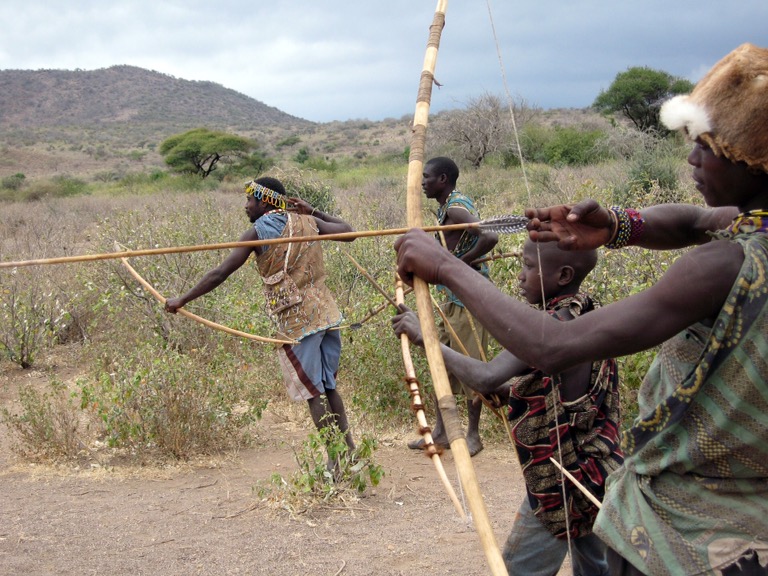
Hadza is a language spoken in Northern Tanzania, in the region surrounding Lake Eyasi.
- It is spoken by all who belong to the Hadza (Hadzabe), a nomadic tribe which forages and hunts most of the food they consume.
- Many Hadza are bilingual in the surrounding languages of the area.
Hadza is a language isolate.
- It was previously believed to be a Khoisan language, a proposed group of languages which use click consonants.
Less than one thousand native speakers of Hadza remain.
- According to Ethnologue, there are 950 speakers (2013 figure).
- Hadza is classified as a ‘threatened’ language.
Hadza is by default a VSO (verb-subject-object) language.
- However, VOS (verb-object-subject) and SVO (subject-verb-object) are used very commonly.
Hadza has no written language.
- However, it has been represented phonetically in writing using English characters.
Before the introduction of Swahili, Hadza had no number system, merely distinguishing between singular and plural.
Here is a very brief video demonstrating what the Hadza language sounds like:
For more videos of the Hadza language, please visit this page.
References
https://en.wikipedia.org/wiki/Hadza_language
https://www.lakeforest.edu/academics/programs/environmental/courses/es368/vlaar.php
Lewis, M. Paul, Gary F. Simons, and Charles D. Fennig (eds.). 2016. Ethnologue: Languages of the World, Nineteenth edition. Dallas, Texas: SIL International. Online version: http://www.ethnologue.com.
 Polyglot in Progress