
Dialogue
Vocabulary and phrases
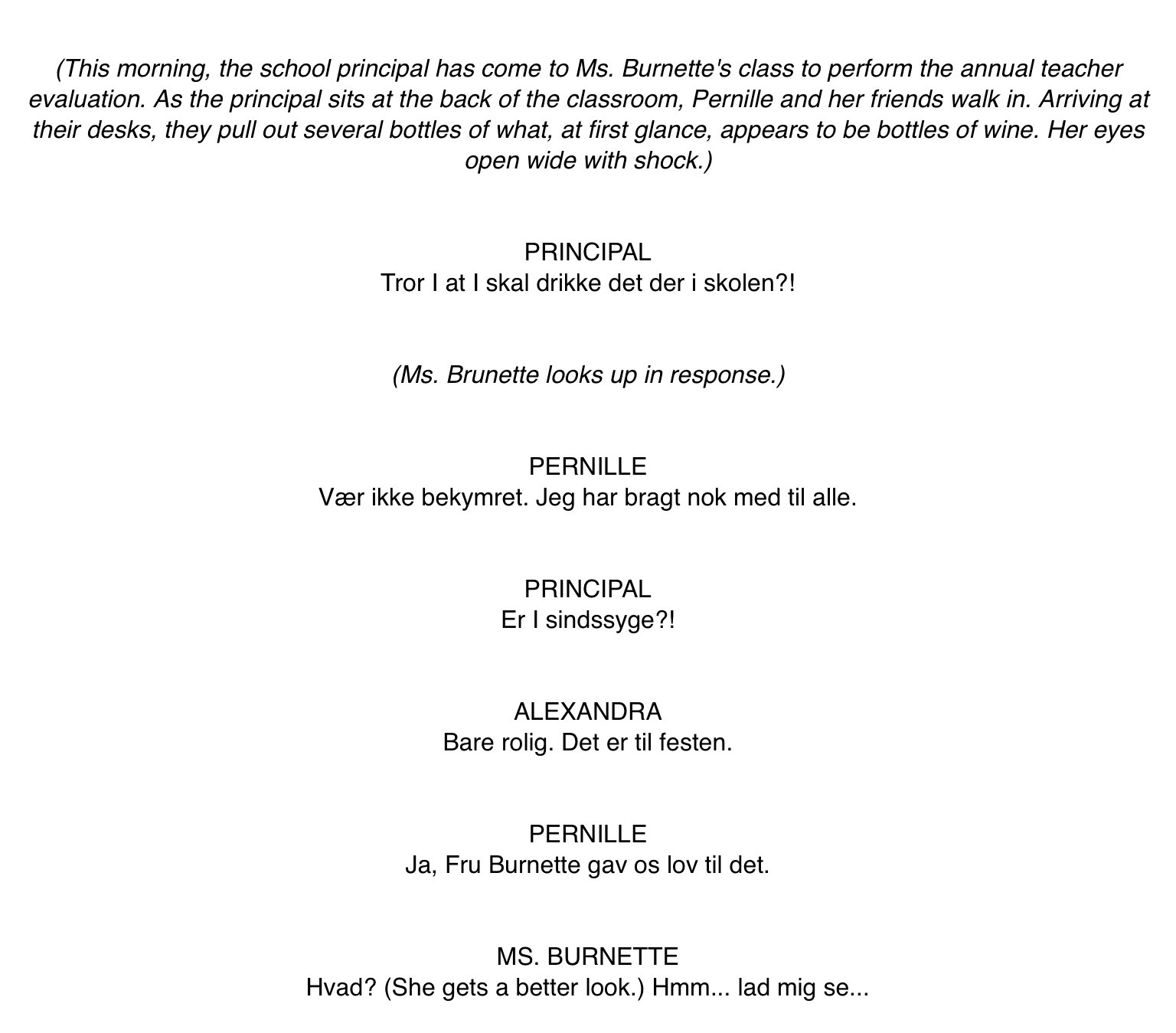
Tror I at I skal drikke det der i skolen?! Do you (pl.) think that you’re going to drink that at school?!
- at tro to think, to believe (not used to express something that is only an opinion)
- at drikke to drink
- en skole a school
Vær ikke bekymret. Jeg har bragt nok med til alle. Don’t worry. (Lit: Don’t be worried.) I bought enough for everyone.
- bekymret worried
- bragt brought (from at bringe)
- nok enough
- til alle for everyone
Er I sindssyge?! Are you (pl.) insane?!
- sindssyg insane, crazy
Bare rolig. Det er til festen. Relax. (Or ‘Take it easy.’; ‘Calm down.’) It’s for a party.
- rolig calm, peaceful
- en fest a party
Ja, Fru Burnette gav os lov til det. Yeah, Ms. Burnette gave us permission.
- lov permission
Hvad? Lad mig se. What? Let me see.
- at se to see
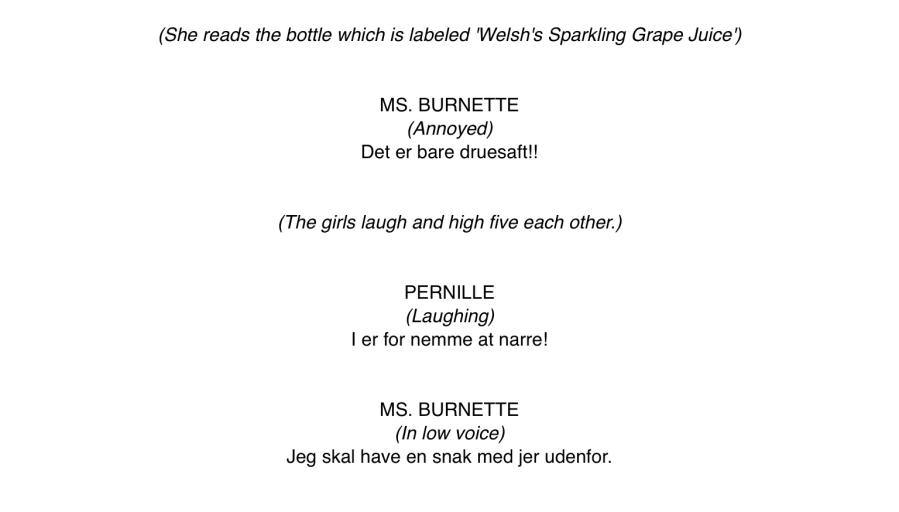
Det er bare druesaft!!! It’s just grape juice!!!
- druesaft grape juice
I er for nemme at narre! You (pl.) are too easy to fool!
- nem easy
- at narre to fool, to deceive
Jeg skal have en snak med jer udenfor. I need to talk with you outside.
- en snak a talk, a chat
- udenfor outside
Grammar
Present tense verbs
Present tense verbs in Danish are easy to form. Well, almost. Like in any other language, there are always some irregular verbs. But first, let’s deal with regular verbs. For regular verbs, you simply add ‘r’ to the infinitive. For example:
- at spise (to eat) becomes spiser (eat, eats)
- at køre (to drive) becomes kører (drive, drives)
- at skrive (to write) becomes skriver (write, writes)
Fortunately, irregulars aren’t too much different (note how they mostly still end in ‘r’ in the present tense). Here are some common examples:
- at være (to be) becomes er (am, are, is)
- at have (to have) becomes har (has, have)
- at gøre (to do) becomes gør (do, does)
- at bo (to live, to reside, to stay – only refers to staying or residing somewhere) becomes bør (live(s), reside(s))
The best part is that Danish verbs don’t change according to person or number. For example:
- jeg er I am
- du er you are (singular)
- han er he is
- hun er she is
- den, det er it is
- vi er we are
- I er you are (plural)
- de er they are
For those of you who learn best through videos, here’s a good one to explain what you’ve learned here:
 Polyglot in Progress