‘Romani’ is referred to both as a language and as a group of languages.
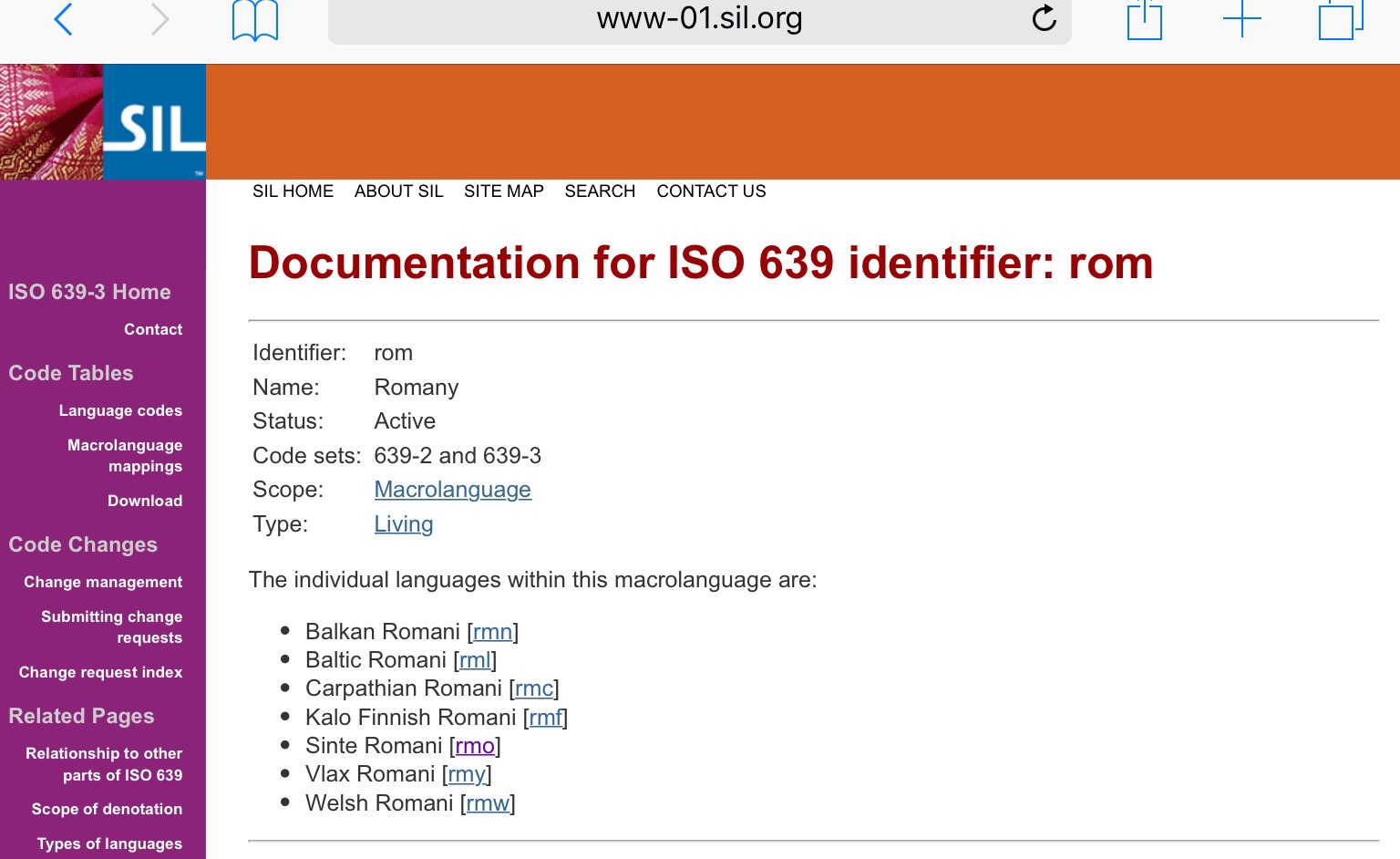
- It is listed as a macrolanguage under ISO coding. Within this macrolanguage, are listings for all Romani dialects that are divergent enough to be considered separate languages.
Although there are no reliable figures on the number of Romani speakers, there are estimated to be more than 4 million speakers of the various Romani dialects.
- At least 3.5 million Romani speakers live in Europe. At least 500,000 can be found in other parts of the world.
Romani is part of the Indo-Iranian branch of the Indo-European family of languages.
- Within this language branch is the Indo-Aryan group of languages, in which Romani is listed.
- Other Indo-Aryan languages include Hindi/Urdu, Punjabi and Bengali.
Here are the highlights of the seven varieties of Romani which can be considered separate languages.
Balkan Romani
- As its name suggests, the Balkan Romani group of dialects is spoken by Roman group living in the Balkans.
- There are approximately 589,500 speakers of Balkan Romani, according to Ethnologue.
Baltic Romani
- Baltic Romani is spoken in the Baltic states and neighboring parts of Poland and Russia.
- At least half of the speakers of Baltic Romani live in Poland.
Carpathian Romani
- Carpathian Romani is actually a group of dialects, which are divided into three groups: Northern Central, Gurvara, and Southern Central.
- According to Wikipedia, Carpathian Romani dialects are spoken from southern Poland to Hungary, and from eastern Austria to Ukraine.
- Within the Northern Central group is the Bohemian dialect which became extinct after the Holocaust as a result of the extermination of most of the existing Bohemian Romani speakers. It is very much worth reading this Wikipedia article to understand the history of the language.
Finnish Kalo
- Finnish Kalo is a Romani language spoken in Finland and Sweden.
- There are approximately 11,650 speakers of Finnish Kalo.
Sinti Romani
- Sinti Romani is spoken by the Sinti people – a Romani ethnic group in Central Europe.
- The language has significant German influence. As a result, it is not mutually intelligible with other Romani dialects/languages.
- There are approximately 320,000 speakers of Sinti Romani.
Vlax Romani
- There are approximately 485,000 speakers of Vlax Romani. Of these, approximately 242,000 live in Romania.
- The term ‘Vlax’ refers to the Roma people who lived in Romania for centuries in slavery. As a result Vlax Romani has had extensive influence from Romanian. However, the similarities between the names ‘Romani’ and ‘Romanian’ are merely coincidental. These names have completely different origins.
- The languages themselves also have very different origins. Romanian belongs to the Romance language branch of Indo-European languages while the Romani languages belong to the Indo-Aryan language group which in turn is part of the Indo-Iranian branch of Indo-European languages.
Welsh Romani
- There are no longer any native speakers of ‘pure’ Welsh Romani. Any remnants of Welsh Romani spoken today is mixed with Welsh and/or English.
For more Romani language resources, see this page.
References
https://en.m.wikipedia.org/wiki/Romani_language
http://romani.humanities.manchester.ac.uk/whatis/status/numbers.shtml
http://romani.uni-graz.at/romlex/dialects.xml
https://en.m.wikipedia.org/wiki/Sinte_Romani
http://archive.ethnologue.com/15/show_language.asp?code=rmo
http://www-01.sil.org/iso639-3/documentation.asp?id=rom
http://www.valleystream.co.uk/romhome.htm
http://www.ethnologue.com/18/language/rmn/
 Polyglot in Progress