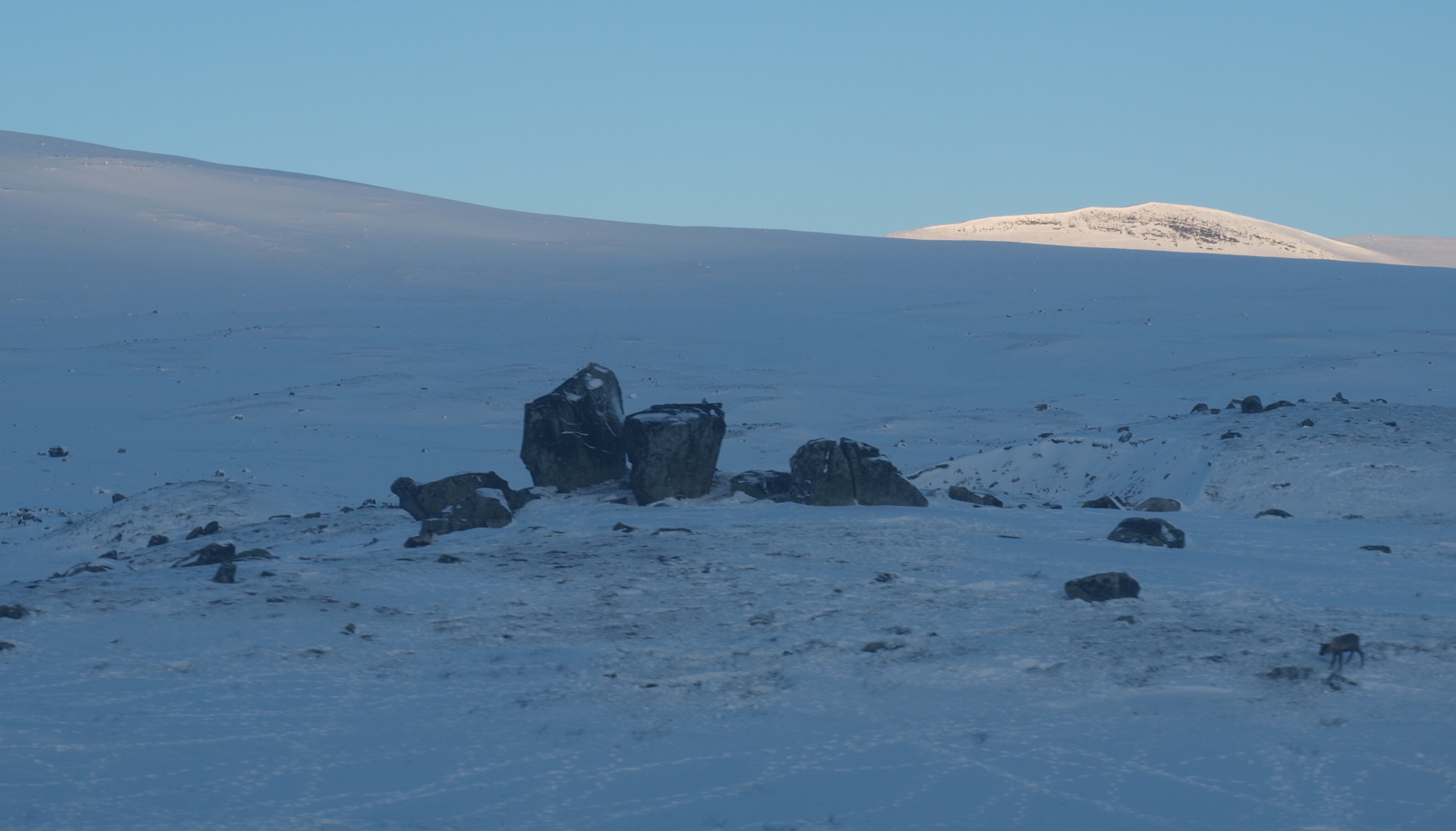
Top photo credit: Olve Utne, March 2010
Pite Sami is also known as Arjeplog Sami.
- The alternative name ‘Arjeplog Sami’ originates from the area where the few remaining speakers are round.
- In Pite Sami, the language is called Bidumsámegiella, which translates as ‘Pite Sami’s language’.
- Saami and Sámi are alternative spellings of ‘Sami’.
Pite Sami is a critically endangered language.
- There are only about 20-30 native speakers left.
- This language was traditionally spoken in Norway and Sweden.
- Its few remaining speakers all live in Sweden, therefore, all of today’s Pite Sami speakers are fluent in Swedish.
As with other Sami languages, Pite Sami is part of the Uralic language family.
- It is part of the Western Sami subgroup.
- Other Western Sami languages include Southern Sami, Ume Sami, Lule Sami and Northern Sami.
- Pite Sami is closest to Lule Sami to its north and Ume Sami to its south.
- According to one source, the Sami languages together form a dialect continuum from southwest to northeast, beginning with Southern Sami and ending with Ter Sami. Other sources simply claim that this dialect continuum only exists between certain parts of the area where the Sami languages are spoken. The extinction of some Sami languages and the decline of the other Sami languages is one reason for this.
Pite Sami grammar, like other Sami languages, can be quite complex.
- Pite Sami has nine cases (for more information on these cases, see here).
- Pite Sami verbs and pronouns not only take into account whether they refer to first, second or third person, but also whether it is singular, dual or plural. Therefore the plural in Sami refers to three or more (people or things).
Pite Sami is one of four Sami languages without an official written language.
- However, there is a grammar book on the language: http://langsci-press.org/catalog/book/17
- There is a working system presently in use for writing in the language, however because there is yet no official standard, it is subject to inconsistencies.
Why has the language experienced such a steep decline?
- Over time, the Sami people were forced to assimilate into the dominant cultures of those ruling over various parts of traditionally Sami territory. Along with the loss of their way of life came the sharp decline in use of many of the Sami languages.
- In the mid 19th century, all Pite Sami children were separated from their families and sent to special schools where they were forbidden to use the language.
Check out these resources to learn about what has been done to preserve the language.
- Pite Saami Documentation Project
- Grammar book (as mentioned above)
- Arjeplog (the remaining Pite Sami area) becomes the first municipality in Sweden to get Sami street names (in Swedish)
- Article about Pite Sami in Nynorsk
- Article on the work that has been done in recent years to preserve the language gulch includes a brief video
- For more resources, visit this page.
Listen to a sample of Pite Sami (explained in Norwegian) in this video (for those who don’t understand Norwegian, I’ve offered an English transcript you can use to follow along):
Transcript with English (you may want to print this out) :
(Norwegian) Her er noen naturbetegnelser på pitesamisk.
(English) Here are some nature vocabulary in Pite Sami.
(Pite Sami – Norwegian – English)
várre – fjell – mountain
vágge – fjelldal – glen
vuobme – skog, skogdal – forest, forest valley
tjåkka – tind, fjelltopp – peak, mountaintop
jegŋa – is, isbre – ice, glacier
jåhkå – elv, bekk – river, stream
jávvre – innsjø – lake
vuodna – fjord – fjord
(Norwegian) Pitesamisk har mange ord som beskriver hvordan naturen er.
(English) Pite Sami has many words that describe how nature is.
(Norwegian) Her er noen av ordene som viser hvordan fjell ser ut.
(English) Here are some of the words that describe how mountains look like.
(Pite Sami – Norwegian – English)
gájjse – spiss fjelltopp, tind – pointed mountaintop, peak
bákkte – berg, klippe – berg, cliff
åjjve – rund fjelltopp – round mountaintop
ållge – aksel – mountain shaft
tjavelk – fjellrygg – mountain back
njonnje – fjellnos – mountain nose
tjåkka – tind, fjelltopp – peak, mountaintop
várre – fjell – mountain
Take a look at traditional Pite Sami clothing:
http://alnakka.net/w/index.php?title=Pitesamisk_drakttradisjon
References
https://en.wikipedia.org/wiki/Pite_Sami_language
 Polyglot in Progress