
I recently took a Frisian language class on FutureLearn. The class has finished, but there will be another one soon if you’re interested in the language. In the meantime, I hope to get you interested in the language, by sharing some of what I’ve learned in the form of this fun little lesson.
Dialogue
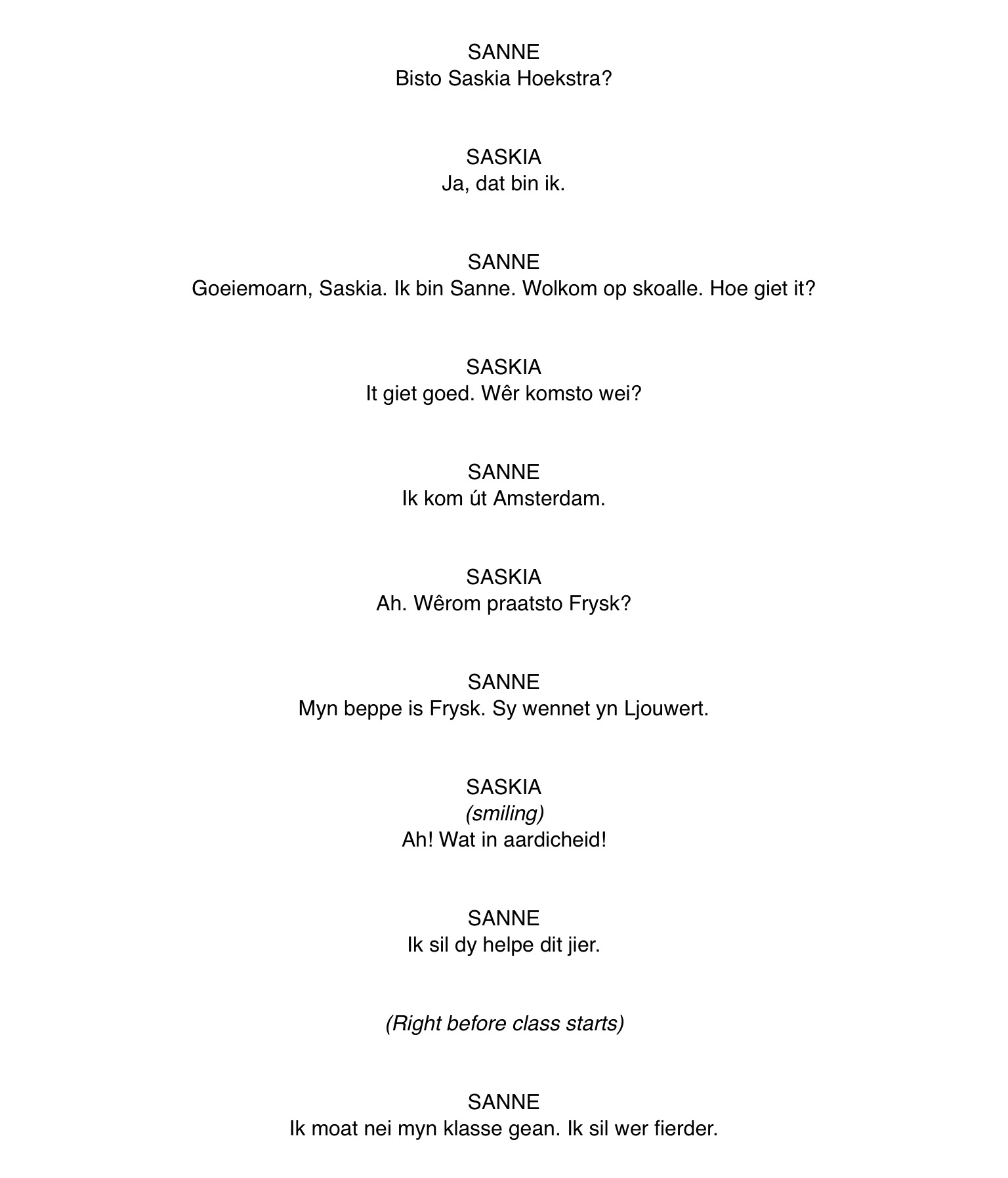

Vocabulary and phrases
Bisto…? Are you…?
Ja, dat bin ik. Yes, that I am.
- ja yes
- dat that
- ik I
- ik bin I am
Goeiemoarn. Good morning.
Ik bin Saskia. I am Saskia.
- As an alternative, one can introduce themselves using ‘myn namme is…‘ which translates as ‘my name is…’.
Wolkom op skoalle. Welcome to the school.
- wolkom welcome
- op to, on
- skoalle school
Hoe giet it? How’s it going?
- hoe how
- giet goes, going (from ‘gean‘, meaning ‘to go’)
It giet goed. It’s going well.
- goed good, well
Wêr komsto wei? Where do you come from?
- wêr where
- do komst you come
- When the pronoun ‘do‘ comes after the verb, it is merged into one word as seen in the sentence above from the dialogue.
Ik kom út Amsterdam. I come from Amsterdam.
- ik kom I come (from ‘komme‘, meaning ‘to come’)
- út out, from
Wêrom praatsto Frysk? Why do you speak Frisian?
- wêrom why
- do praatst you speak (see note above regarding use of the pronoun ‘do‘)
- Frysk Frisian
Myn beppe is Frysk. My grandmother is Frisian.
- myn my
- beppe grandmother
Sy wennet yn Ljouwert. She lives in Leeuwarden.
- sy she (unstressed form – se)
- wennet lives (from ‘wenje‘, meaning ‘to live’)
- yn in
- Ljouwert Leeuwarden
Wat in aardicheid! How wonderful!
Ik sil dy helpe dit jier. I’ll be helping you this year.
- ik sil I will, I shall (from ‘sille‘, meaning ‘will, shall’)
- dy you (object pronoun)
- helpe to help
- dit this
- jier year
Ik moat nei myn klasse gean. I have to go to my class.
Ik sil wer fierder. I’m heading off.
Tige tank. Thank you very much.
- Tank. Thanks.; Thank you.
Grammar
Subject pronouns
- ik I
- do you (informal, casual)
- jo you (formal)
- hy he
- sy/se she
- wy/we we
- jim you (plural)
- sy/se they
For some of the pronouns, you may have noticed that there are two forms. The first form given is the ‘stressed’ form, while the second form is the ‘unstressed’ form.
If you want to learn more…
This course will be offered again through FutureLearn. As soon as I find out the date, I will share it in a future post.
 Polyglot in Progress