
Before proceeding, make sure you are familiar with how Icelandic is pronounced. Here is a good place to start. Also, some of the vocabulary words are linked to a page where you can hear the word or phrase pronounced by native speakers.
Conversation

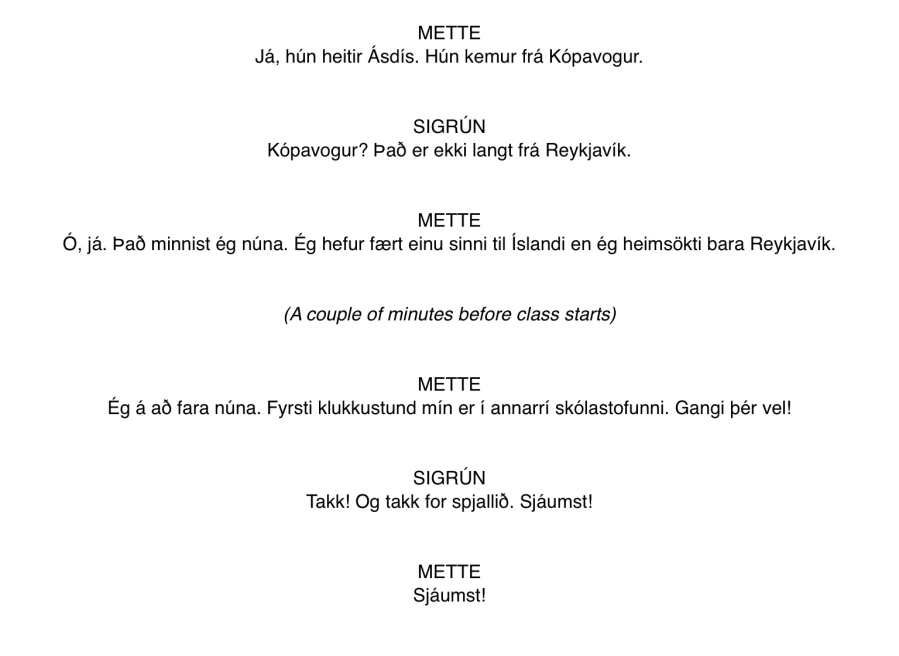
Vocabulary
hæ hi
Ég held að þú biður eftir mér. I think you are waiting for me.
Ertu…? Are you…?
Hvað heitirðu? What is your name? (Literally: What are you called?)
hvað what
að heita to be called
þú you
Ég heit… My name is…
Ég ætla að… I am going to…
að hjálpa to help
þér you (dative form; In Icelandic objects of a sentence generally use the accusative or dative forms)
að venjast to get used to
þessum this (dative form)
skoli school
skola school (accusative, dative, and genitive form)
íslenska Icelandic (language)
íslensku Icelandic (accusative, dative, and genitive form)
nafn name
já yes
jú yes (when confirming something already stated or stating something obvious to the listener)
Ég kem frá… I come from…
Noregur Norway
Noregi Norway (dative form)
en but
ég hef lært I have learned
þegar when
ég I
var was
yngri younger
ein af vinkonum mínum one of my (female friends)
kemur frá Íslandi comes from Iceland
Í alvöru? Really?
hún she
ekki not
langt frá far from
ég man það I remember that
núna now
ég hef fært I have gone
að fara to go
einu sinni once, one time
ég heimsökti I visited
að heimsækja to visit
Fyrsti tíminn minn er í annarri stofu. My first class is in another classroom.
Takk fyrir. Thank you.
Gangi þér vel! Good Luck!; May it go well for you!
Sjáumst! See you later!
Grammar
For this first lesson, I won’t focus on any grammar. But in the next lesson, I will explain what nominative, accusative, dative, and genitive forms are with a simple overview of when they are used.
 Polyglot in Progress